
The physical Tacit Tessera
A plate and a card, made at issue.
When a number is issued, two objects are made for that one skill set and posted to its Source: a plate, which is the tile made solid, and a wallet card. They are a record of the number, not a credential. None has been made, because nothing has been issued.
Every skill set in the register has a tile: a machined plate drawn on a screen, carrying its number, its collector's mark and its pattern. The physical Tacit Tessera is that tile taken off the screen. One skill set, one number, one plate, one card — and a second number, if the skill set ever takes one, gets its own pair.
The plate measures 70 × 44 × 4 mm. It is the tile made solid, so what a reader saw beside the entry in the Book is the same shape, the same marks and the same colour they can now turn over in their hand.
The card is CR80, 85.6 × 54 mm — the size a bank card uses. It carries the same marks at wallet size and goes in the same envelope.
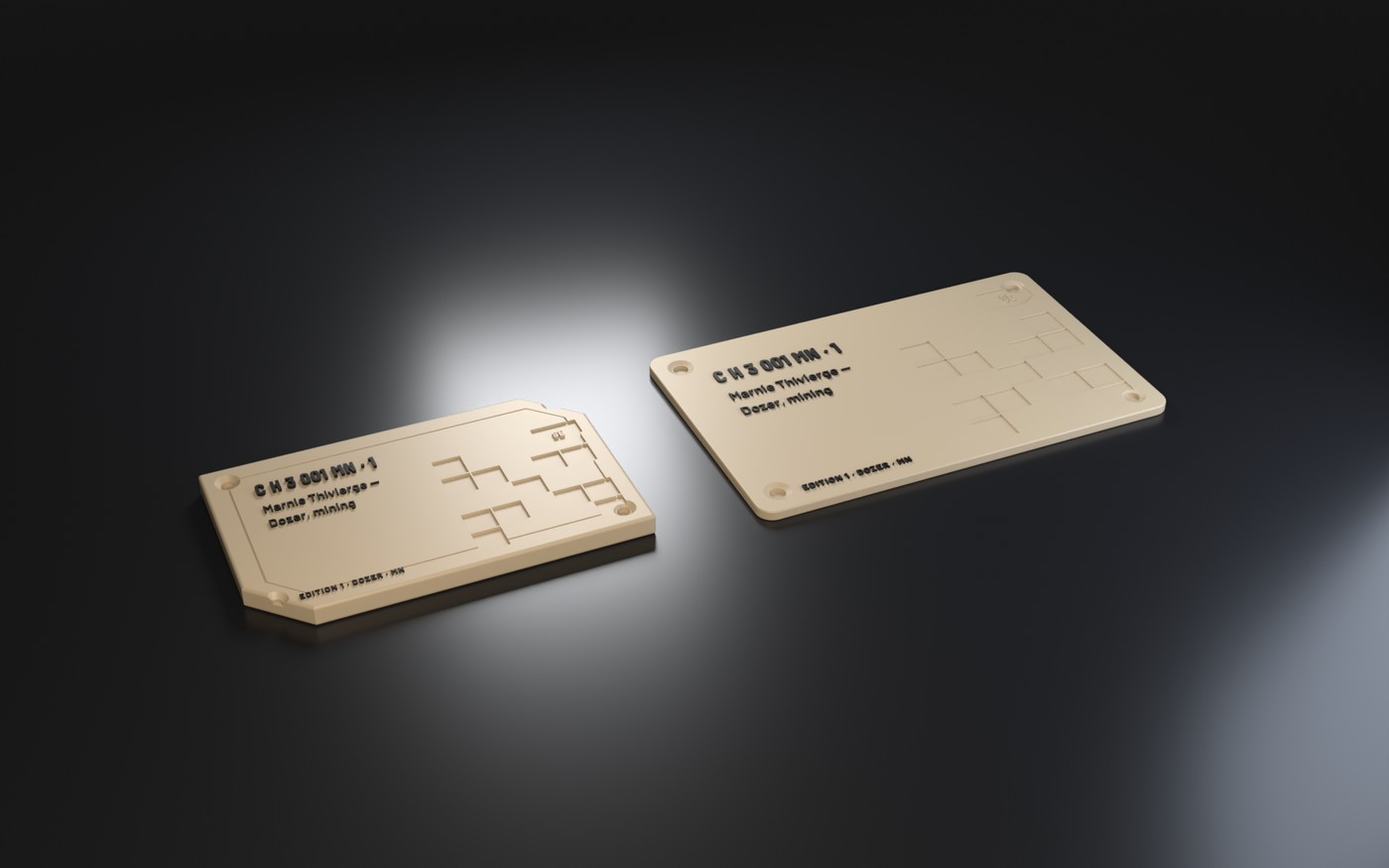
The tile the plate is made from EXAMPLE · Tacit Tessera C H 3 001 MN · 1, drawn by the register.
The front carries the plate geometry the mark uses: two chamfered corners, a bevel, an inset scribe line and four countersunk marks. Within that frame, three things are made in relief and one is cut in.
- The number, raised
- The human form, sector letter first, standing proud of the face so it can be read across a desk and felt with a thumb.
- The name, raised
- Beside the number, never instead of it: the person on a Hands set or a named practice, the package on a Machine set, the seat or scope on a company's Records set.
- The collector's mark, a die
- The two-letter die at the top right, stamped into the face — SE where Steady Eddie brought the skill set to the register, SA where Strategic Agent did. Even Steven owns what is made of every skill, and where it collected the set its mark, ES, is on the tile and on the plate.
- The pattern, recessed
- The small symmetric pattern the tile carries, cut into the face rather than raised, so it reads as texture and never competes with the number.
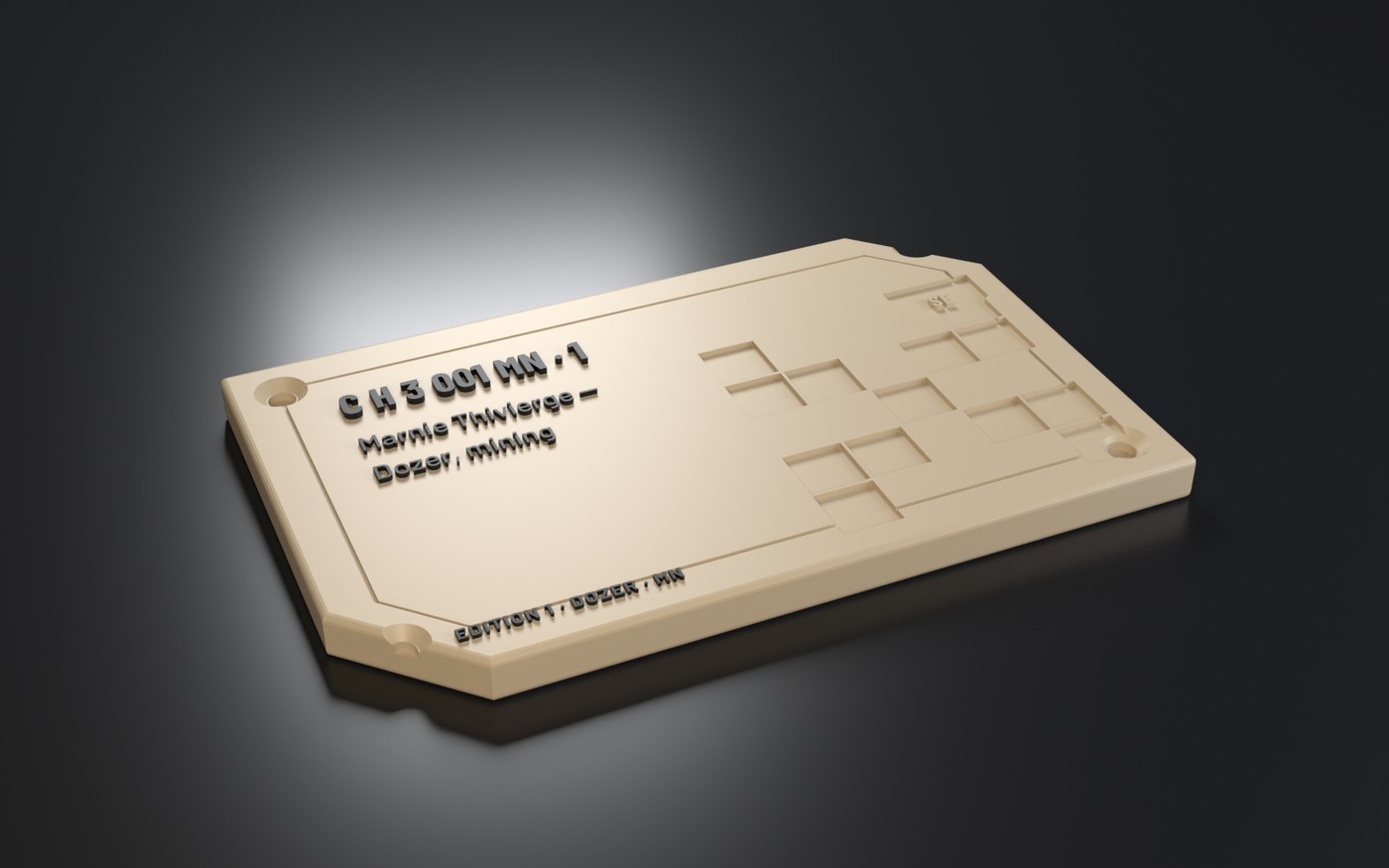
Nothing else is on the front. No rank, no level, no star, no date of issue, no photograph, no rate and no figure of any kind beyond the number itself.

The back carries one thing: the verify address, with the ten characters of the machine form written out. It is the address that makes the plate worth holding, because the plate itself settles nothing. A check answers four things and nothing else — whether the check character is valid, whether the register knows the number, its status, and whether this edition is current.
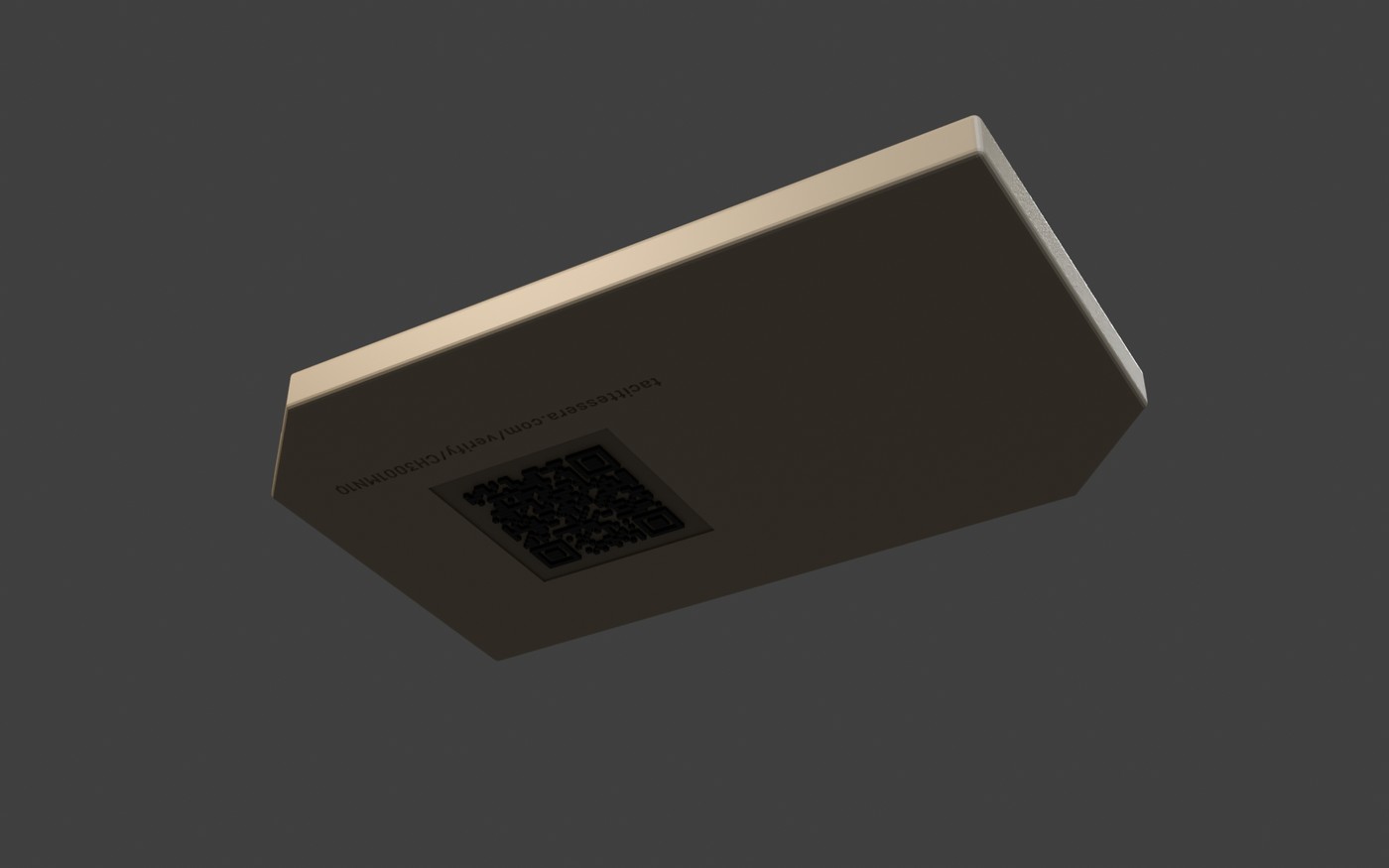
Nothing is stored as a verdict. Every lookup is worked out again from the sealed Card, which is why the authority sits at the address and never in the object.
tacittessera.com/verify/CH3001MN1Q
The card is the plate at a size that fits behind a driving licence. It carries the same marks: the number with the name beside it, the collector's die, the pattern, and the verify address on the back. It is the same object at the size a person will actually carry, and it is issued by Tacit Tessera.
A printed card cannot be recalled once it is in a wallet. Its authority is the verify page, worked out again at every lookup, and never the plastic. The wallet card set out on the cards is the operator's card for a Hands skill set; the card in this envelope is its counterpart for whatever kind of skill set the number names.

Each is made in the tile's own colour. That colour is not decoration and not a grade: each family has a band of hues, a tile's colour is chosen at issue and recorded on its Card rather than worked out again, and a brand red is never issued as a tile colour, so no plate competes with the mark.
Colour never carries meaning on its own. The number is raised on every plate and printed on every card, so the object still reads in the dark, in black and white, and to a reader who does not see the hue.
The pair is made when the number is issued, and it goes to the Source: the person whose way of working it is on a Hands set or a named practice, or the company whose records it was built from. It goes with the wallet card in the same envelope. Nobody buys one, nobody is sold one, and it is not a thing a licensee receives — a licensee gets a numbered, sealed edition, a count of every use and the seal check.
Steady Eddie and Strategic Agent require skill sets. Even Steven owns them. Tacit Tessera licenses them to OEMs and to AI. The plate says which skill set, who collected it and where to check it. It does not say who is licensed to run it, and it never changes hands with a licence.
It is not a credential. It says a number exists and names its skill set; it says nothing about how well anyone works, and it grades nobody. It is not a token, a badge or a trophy, and it confers nothing that the register does not already hold.
It is also not the thing that makes a number real. Only the register issues numbers, and a number not in the register is not a Tacit Tessera number, however it is written — on paper, on plastic or on a plate. If the object and the register ever disagree, the register is right.
No plate and no card has been made for anybody, because no number has been issued to anybody. No capture session has been recorded, no operator has been signed, nothing has been metered and nobody has been paid.
The tile, the Card page and the printed set are on the cards. The number itself is set out on how numbering works.
tacittessera.com/verify